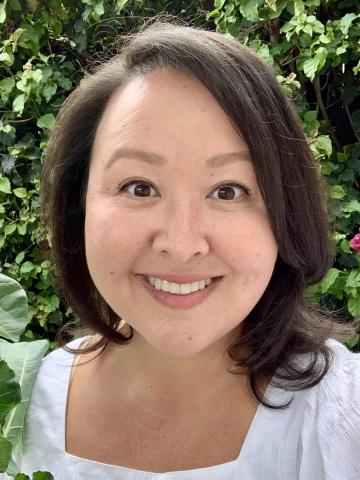
Peer advisor Hope Fu interviewed journalist and alum Victoria Namkung, whose recent work includes an article about innovative protest and a piece about protest art. Hope began by asking, How has your education within Asian American studies influenced your work?
“A ton!” Victoria laughs. Prior to attending university, she had never even been taught about Japanese American Incarceration, which she notes as a basic fact of US history. Asian American studies granted her historical knowledge she calls on regularly to accurately cover the current events that parallel earlier American history. In addition, learning to read academic papers and to do research are both incredibly relevant skills for her current career. In fact, she poses the opposite question: “What can’t you do with an Asian American Studies degree?”
What does a typical work day look like for you? What does your process look like for each article?
A morning person, Victoria prefers doing her research and interviewing prep early. Reporting often entails traveling to cover different stories across the West Coast. A story can take her between a week or a month. The writing part usually goes the fastest for her — though features, her stories are not overly long. It also works well that her editor is a biracial Asian American, to whom Victoria doesn’t have to spend so much time explaining historical issues.
How did you become a novelist? What inspires you to write? What kinds of stories do you want to tell?
First, Victoria notes that both books were written before Me Too, based on her own experiences and those of friends and colleagues. She felt that she had to platform these stories about the unspoken “second set of rules for women,” who are “gaslit” by a culture which says that women can do anything but then is quick to crush them for trying.
Her first book, The Things We Tell Ourselves (2015), centers a female journalist who is sexually blackmailed after an affair with an older reporter. Her second book, These Violent Delights (2017), tells the story of sexual abuse at an elite private school.
Do you have any advice for young writers planning on pursuing a career in journalism?
Reach out to any journalist you’re a fan of: all are willing to help out aspiring journalists. Also, anyone can join the Asian American Journalists Association, and the organization will pair you with a mentor, whether from broadcast journalism, bloggers, or print media. “Journalism happens really fast when you start publishing professionally,” she says, “As long as you be nice, meet your deadlines, and be a good writer, anything is possible.”
Starting early is helpful, whether in a student newsletter, zines, or an alumni newsletter. Having published writing samples or clips to show people is important. She discusses how Harvard’s student newspaper recently uncovered information from within the school, and how she’s proud that young journalists have the courage to go against their schools.
Victoria herself founded a zine in college that exclusively covered the Asian American studies department. In it, she included pieces of writing, poems, and interviews. Though she thought it was insignificant at the time, she actually received that first internship with the Los Angeles Magazine because of the zine.
How important do you feel your role as a journalist is in the current political climate?
Victoria emphasizes that while “journalism has never been more important, it is currently valued the least.” Americans’ trust in the media is at an historic low. Since the Civil Rights Movement and the Vietnam War, conservatives have attacked the free press in order to make reporting look like left wing conspiracy. [Present-day financial models also mean] it is almost impossible now to only be a journalist. Many of her colleagues have become authors and teachers. Victoria herself is a novelist and former college instructor.
Yet she also sees the value of social media. While she cautions that influencers are not journalists, and not all of them are well intentioned, she cites the Stop AAPI Hate movement as something that could have only been accomplished on social media. “Dictatorships have been fought via social media,” she says, which she credits for bringing in younger, more diverse voices.
Her current employer, the Guardian, is reader funded, which means they can avoid issues that other publications such as the Washington Post (owned by Jeff Bezos since 2013) cannot. “It feels more like the journalism of old — not shackled by corporate entities or political people.” The publication is also based in the UK, which means the stories have more of a global audience.
Your recent article centered on new protestors and those who have just joined political movements. Do you have any advice for people trying to organize today?
Reach out to organizers, Victoria advises, who are always looking for the next generation. “The youth have the future,” she says. They have to be concerned about the things that will happen in their lifetimes.
She notes the importance of protesting in personally sustainable ways: “Protest doesn’t always have to be marching in the street.” It’s important to find something fun that builds community, so you keep coming back. Do it with a friend: it can be intimidating to walk into a room alone. She herself is not an expert at organizing, and due to journalistic ethics, cannot personally organize, but she finds meaningful work through journalism. “Use the tools you have. Do one or two things that you can sustain.”